Energy
 Aviation
 Automotive
 Manufacturing
 Maintenance services
 Medical
How to Implement AR in Your Company – From Pilot to Scale
Augmented Reality (AR) is no longer an experimental technology—it is becoming a practical business tool, especially in areas such as maintenance, training, field service, and HSE. The key question today is no longer if to adopt AR, but how to implement it in a way that delivers measurable value and scales effectively.
Below is a practical roadmap—from MVP to pilot to full rollout—along with real-world barriers, cost considerations, and common mistakes.
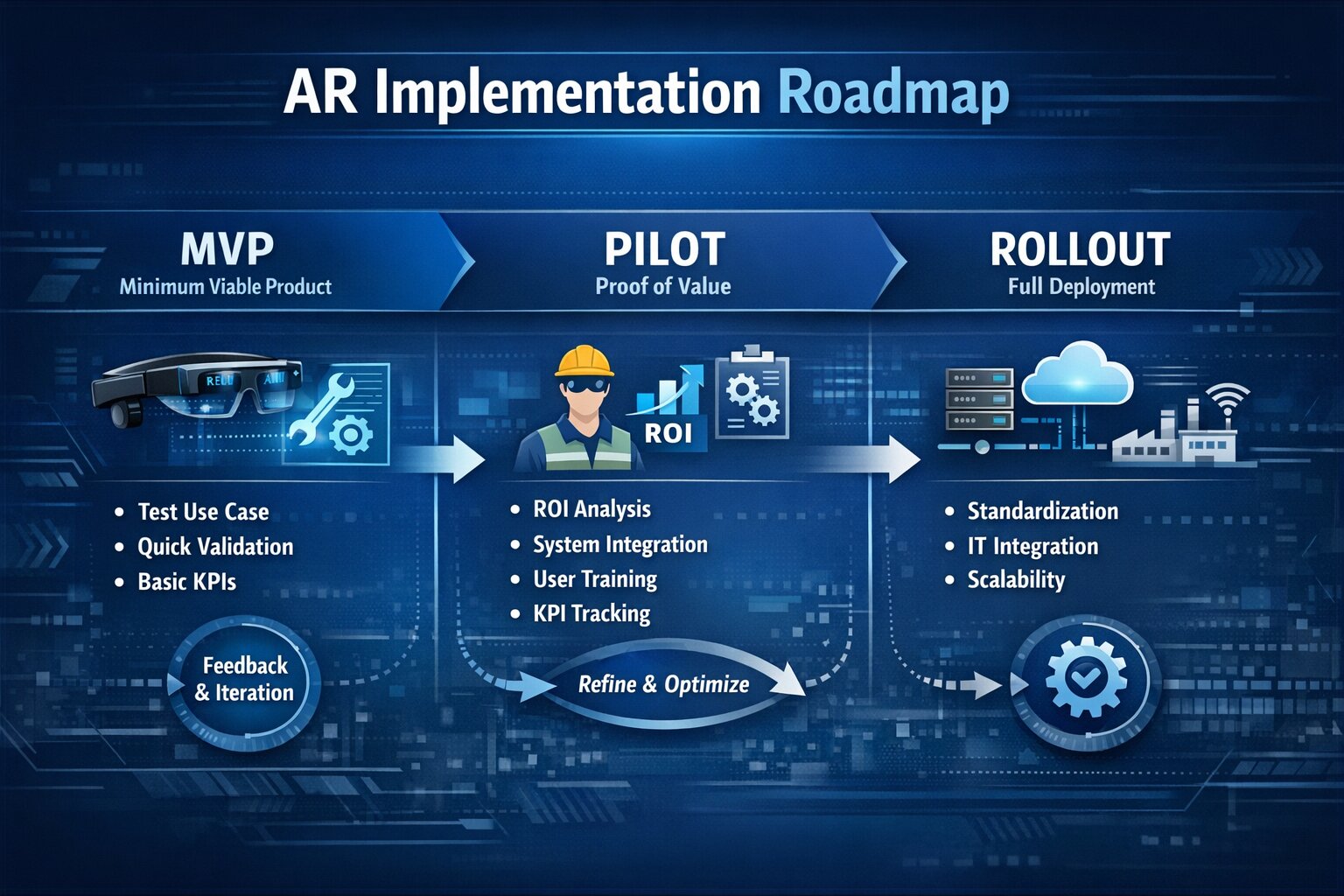
1. MVP → Pilot → Rollout: A Proven Implementation Path
MVP (Minimum Viable Product)
At this stage, the goal is not perfection, but rapid validation of business value.
- Select a specific use case (e.g., remote expert support, step-by-step instructions, technical training)
- Limit scope to one site or team
- Use existing tools (off-the-shelf AR platforms instead of custom development)
- Define KPIs: task completion time, error rate, safety incidents, training duration
👉 Outcome: quick validation of whether AR improves the process
Pilot (Proof of Value)
This phase answers not just “does it work?” but “does it scale and deliver ROI?”
- Integrate with enterprise systems (CMMS, ERP, technical documentation)
- Test different hardware (smart glasses vs tablets vs mobile)
- Involve end users (technicians, operators)
- Collect feedback and iterate on UX
👉 Outcome: measurable ROI and a refined operating model
Rollout (Scaling)
At this stage, AR becomes part of daily operations.
- Standardize AR workflows and content
- Integrate into IT architecture (SSO, security, device management)
- Train users and establish onboarding processes
- Set up support, maintenance, and governance models
👉 Outcome: AR as a scalable operational capability—not a one-off project
2. Key Implementation Barriers
2.1. Hardware
- Limited ergonomics of smart glasses (comfort, battery life, field of view)
- Device costs at scale
- Suitability for harsh environments (ATEX, offshore, PPE compatibility)
2.2. IT & Integration
- Integration with legacy systems
- Data security and remote access requirements
- Network constraints (latency, connectivity reliability)
2.3. Adoption (People)
- User resistance (“another tool to learn”)
- Poor usability or UX
- Underestimating training and change management
👉 In practice: technology is rarely the biggest challenge—organizational change is
3. Costs – Where Budgets Are Really Spent
AR projects are often underestimated because companies focus only on hardware and licenses.
Real cost drivers:
- Devices (smart glasses / tablets / mobile)
- AR platform licenses
- IT integration (often the largest cost component)
- AR content creation and maintenance (instructions, 3D models)
- Training and change management
- Support and ongoing operations
👉 Key insight:
Content and integration typically cost more than the technology itself
4. Common Mistakes
4.1. No clear use case
Implementing AR because it’s “trendy” → no ROI
4.2. Starting too big
Trying to scale globally instead of validating with a focused MVP
4.3. Ignoring end users
A technically sound solution that no one uses
4.4. Underestimating content effort
AR content is not a one-time effort—it requires continuous updates
4.5. No business ownership
Projects stuck between IT and operations without clear accountability
5. How to Maximize Success
- Start with one high-impact, ROI-driven use case
- Measure performance from day one
- Involve end users in solution design
- Treat AR as an operational transformation, not just a technology deployment
- Build internal capabilities instead of relying entirely on vendors
Conclusion
Successful AR implementation is a process, not a project. Organizations that achieve real value follow a structured approach—from MVP to pilot to full-scale rollout—while maintaining a strong focus on business outcomes.
The real competitive advantage today is not access to AR technology, but the ability to implement and scale it effectively in real operations.